

Hiding the icons on your Mac desktop makes your screen feel much calmer, especially if you have a habit of saving files straight to the desktop. Your co-workers won’t shake their heads anymore when they glance at your screen. And when you need to share your screen during a meeting or record a tutorial video, a clean desktop just looks so much more professional. It only takes 1 second to hide all the icons on your Mac desktop, leaving nothing but a beautiful wallpaper on that gorgeous Retina display.
Why bother hiding desktop icons?
If you are wondering whether this is really worth the effort, here are a few situations where hiding desktop icons genuinely makes a difference.
The most common scenario is screen sharing. Whether you are presenting in Google Meet, Zoom, or Teams, having 200 random files on your desktop is not a great look. Hiding everything in one click before you share your screen is a habit that will save you some awkward moments.
The same goes for screen recording and tutorial videos. A clean background keeps the viewer focused on what you are actually demonstrating rather than getting distracted by your file names.
And honestly, even just for yourself, staring at a cluttered desktop all day can feel subtly stressful. A clean desktop is one of those small things that just makes the work environment feel better.
Hide icons on Mac desktop with an app
Step 1: Open the App Store and download the HiddenMe application to your device. HiddenMe is now a paid app, priced at $1.99 on the US App Store (as of October 2026). There’s also a Pro upgrade as an in-app purchase, but the standard version is all we need.
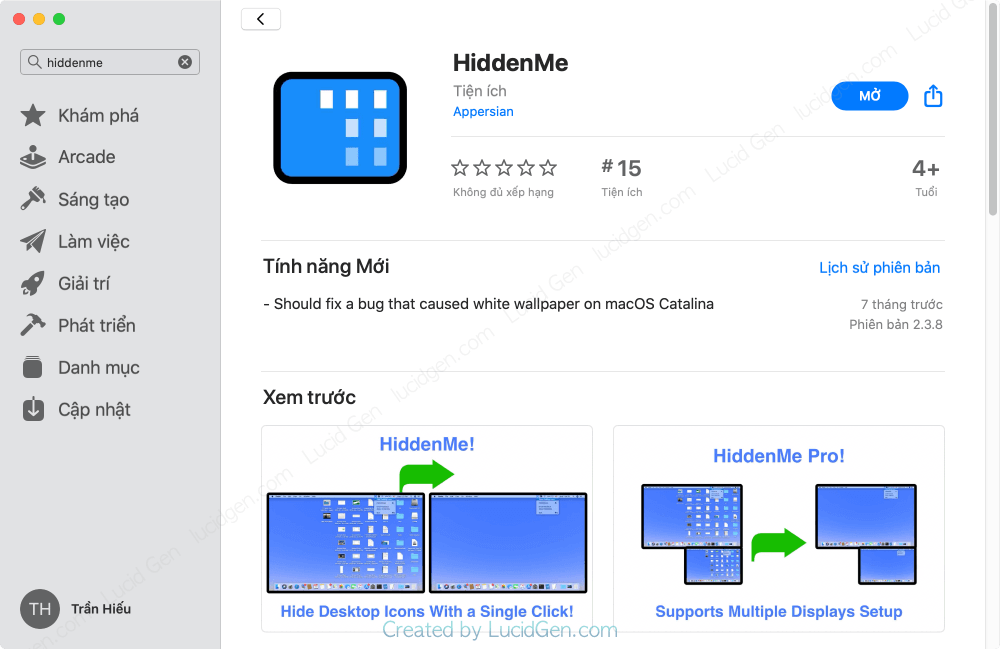
Step 2: Open the HiddenMe application and an icon will appear in the menu bar. Click on the HiddenMe icon and select Hide Desktop Icons to hide all icons on your Mac desktop.
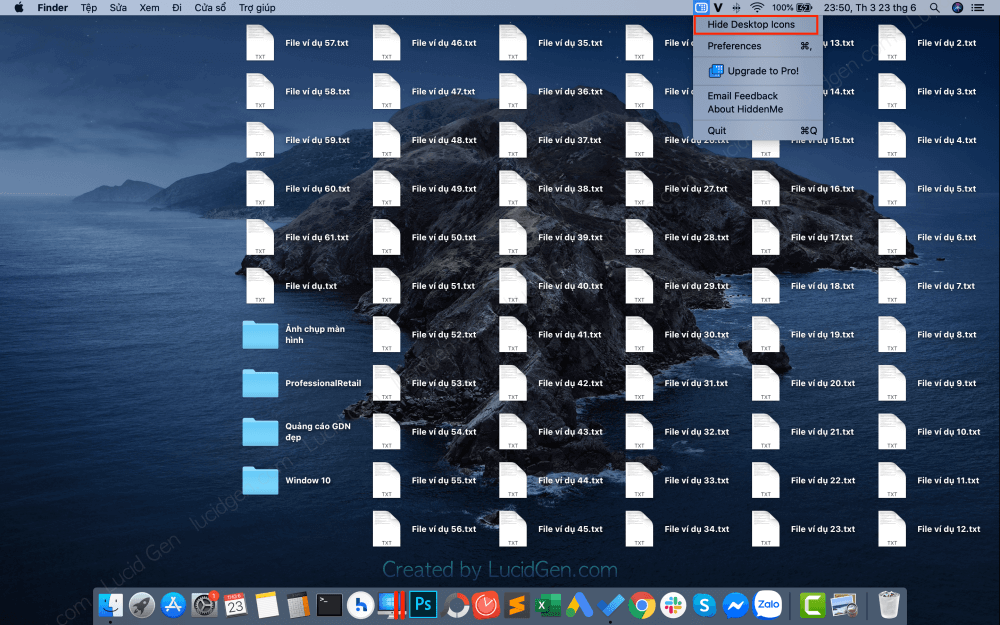
To show the files and icons again, click the HiddenMe icon and select Show Desktop Icons.

Set it up to work in just 1 second
To make using HiddenMe more convenient, click the HiddenMe icon and select Preferences.

There are two options I strongly recommend: Single click to hide/unhide, Right-click for menu and Shortcut. Here is a quick breakdown of all the settings so you know what each one does.
Startup: What happens when your Mac starts.
- Open at Login: HiddenMe launches automatically when your Mac starts up.
- Hide icons at Launch: Desktop icons are hidden as soon as HiddenMe opens.
Background: What shows behind your icons when hidden.
- Use desktop wallpaper: Your current wallpaper stays visible (this is the default and the best option).
- Use solid color: Replace with a plain color of your choice.
- Use custom wallpaper: Use a completely different background image when icons are hidden.
Behaviour: How you interact with HiddenMe.
- Single-click to hide/unhide, Right-click for the menu: A left-click on the HiddenMe menu bar icon instantly hides or shows all icons. Right-click opens the full menu. This is the fastest workflow.
- Double-click on the desktop to show the icons: Double-clicking on the desktop will reveal your hidden icons again. Useful if you forget where the menu bar icon is.
Shortcut: Click the Record Shortcut button and assign a keyboard shortcut. For example, I use Control + D. Whenever I press this combination, HiddenMe instantly hides or reveals all the icons on my desktop. This is hands down the fastest way to toggle the desktop view.

Hide desktop icons without any app (Terminal method)
If you prefer not to install any extra app, you can hide desktop icons using a Terminal command. This method works on macOS Ventura, Sonoma, and Sequoia.
To hide all icons on your Mac desktop, open Terminal and run this command:
defaults write com.apple.finder CreateDesktop false && killall FinderYour desktop icons will disappear immediately. The Finder restarts automatically and takes about two seconds.
To bring the icons back, run:
defaults write com.apple.finder CreateDesktop true && killall FinderThe Terminal method is great if you want a one-time setup, but HiddenMe is much more convenient for everyday use because you can toggle everything with a single click or keyboard shortcut without opening Terminal each time.
Use Stage Manager for a different approach (macOS Ventura and later)
Since macOS Ventura, Apple introduced Stage Manager, which takes a different approach to cleaning up your workspace. Instead of hiding desktop icons, Stage Manager groups your open windows into organized sets and keeps your desktop area cleaner.
You can turn on Stage Manager by clicking the Control Center icon in the menu bar and toggling Stage Manager on. Or go to System Settings, then Desktop and Dock, and enable Stage Manager from there.
Stage Manager does not hide your desktop icons completely the way HiddenMe does. It is more about organizing your app windows. So if you specifically want a clean, icon-free desktop, HiddenMe is still the better choice. If you want a cleaner workflow overall with window management, Stage Manager is worth trying as a complement.
Use Stacks to auto-organize your desktop
Another built-in macOS feature worth knowing is Desktop Stacks. Right-click on your desktop and select Use Stacks. macOS will automatically group files into tidy stacks by type, such as Images, Documents, Screenshots, and so on. Your desktop goes from looking like a disaster zone to looking surprisingly organized.
Stacks do not hide your icons, but they do make the desktop look much tidier at a glance. It is a good middle ground if you want to keep files on the desktop but still look presentable during a screen share. You can use Stacks alongside HiddenMe: keep Stacks on so your files are organized, then toggle HiddenMe whenever you need a fully clean screen.
HiddenMe on newer macOS versions
HiddenMe has been around for years and worked well on macOS Sequoia when I last updated this article. However, its latest App Store update is version 3.1 from October 2022, so if you’re on a newer macOS, check the recent App Store reviews before buying. If the app doesn’t run smoothly, the Terminal method above is a solid fallback. The standard version (without the Pro upgrade) does everything most people need: hide/show icons and set a keyboard shortcut.
The Pro version adds a few extras like supporting multiple displays simultaneously, which is handy if you work with an external monitor setup. But for a single display, the standard version is completely sufficient.
One thing to note: when you first install HiddenMe, macOS may ask you to grant it permission in System Settings under Privacy and Security. This is normal for apps that interact with the desktop. Just allow it and everything will work fine.
Quick comparison: which method to use?
Here is a quick summary to help you pick the right approach for your situation.
Use HiddenMe if you need to toggle desktop icons frequently throughout the day. The keyboard shortcut makes it instant and the app runs quietly in the menu bar without getting in the way.
Use the Terminal command if you want a one-time, app-free solution. Good if you only need this occasionally and do not want an extra app running.
Use Desktop Stacks if your main goal is organization rather than hiding. It keeps everything visible but tidy.
Use Stage Manager if you want a cleaner window management workflow overall, not just a clean desktop.
Conclusion
HiddenMe is genuinely one of those small apps that makes your daily Mac experience noticeably better. It is cheap, lightweight, and does exactly one thing really well. Set up the keyboard shortcut, enable Open at Login, and you will never have to worry about a cluttered desktop ruining a screen share again. If you use the Terminal method or have tried Stage Manager, let me know how it works for you in the comments below.


Great blog here! Also your website loads up fast!
What web host are you using? Can I get your affiliate link to
your host? I wish my site loaded up as fast as yours lol
Thank you! My blog is using AZ Digi Hosting by Vietnam.