

For experienced Google advertisers, the MCC account is a familiar and essential tool for daily work. However, advertisers who are new to Google Ads, or clients working with an agency, are often unsure what a Google Ads MCC account is and what it can do for them. In this article, I will explain what a Google MCC account is, its benefits, and how to create and use one correctly.
What is a Google MCC account?
MCC stands for My Client Center. Google now calls it a manager account, and it works much like a Facebook Business account.
With a single Google MCC account, you can create and manage many child accounts at once, which makes it easy to keep track of different ad accounts and saves you time and effort.
Benefits of a Google MCC account
Using a Google MCC manager account gives you benefits such as:
Manage all your Google Ads accounts from one MCC
With one login, you can access and manage all your Google Ads accounts, including accounts owned by other people.
Track campaigns, invoices, and payments across all your Google Ads accounts
With a Google MCC account, you can see information about every child account on the overview page. Creating and editing campaigns in child accounts is also much simpler than logging in to each Google Ads account separately. You can even combine the invoices of child accounts into a single monthly invoice.
Grant access to other users
You can give other people different levels of access, such as view, edit, or manage campaigns.
Compare and optimize campaigns across child accounts
You can easily compare the results of campaigns in different child accounts, then optimize and adjust your ads to get better results.
Become a Google Partner
After a period of use, with a solid history of activity and on-time payments, you may be able to become a Google Partner.
Who is Google Ads MCC for?
MCC suits large advertisers who own multiple Google Ads accounts, agencies, Google Partners, and online marketers who manage many client accounts or many campaigns at the same time.
How to create a Google MCC account
To create a Google Ads MCC account, you first need a Gmail account. If you don’t have one, visit the Create Google Account page to create it. Then follow the steps below to create an MCC.
Step 1: Visit this page, then click the Create a manager account button.

Step 2: In the next window, fill in the form and click Submit. In this form:
- Set the display name for the MCC account.
- Choose how you will use the MCC account. Pick the option that fits your needs, but I recommend choosing Manage other people’s accounts.
- Google pre-fills these fields based on your Gmail settings. You can change them if you want; here, I keep the defaults.

Step 3: After you click Submit, a window will confirm that your Google MCC account has been created. Click the Explore your account button to get started.

How to create a child account in a Google MCC account
Next, I will show you how to create a child account in your new Google Ads MCC account.
In the main interface of MCC, click Account > Performance > click the blue Plus sign > Create a new account. (Screenshots from the 2020 interface. In the current Google Ads interface (10/2026), click the Accounts icon in the left menu, select Sub-account settings, then click the plus button.)
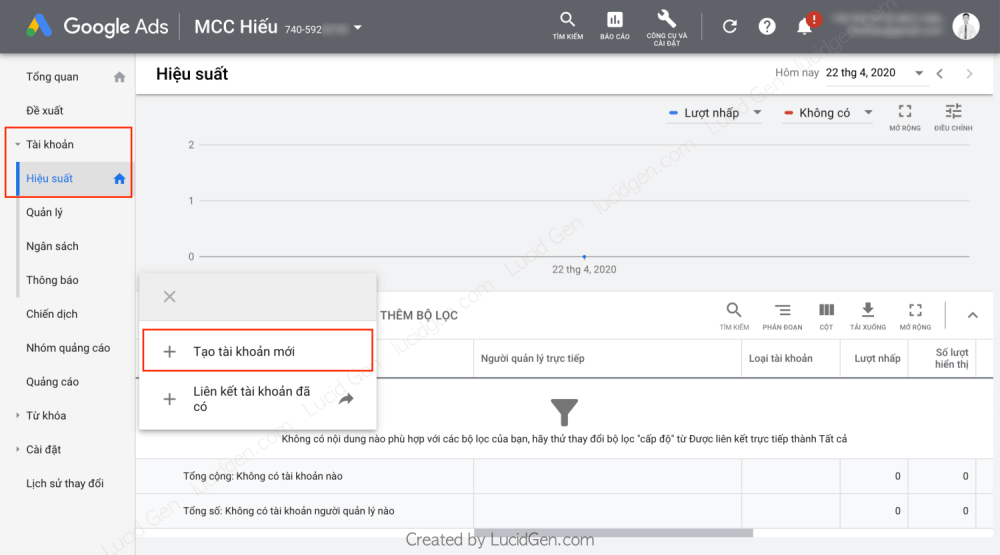
Enter a name for the child account in the window that appears. Google pre-fills the other fields, which you can keep or edit, then click Save and continue.

Next, set up a payment profile and fill in your payment information, including your name, address, city, province, and postal code.
Some common postal codes (Vietnam uses 5-digit codes, as of 10/2026):
- Hanoi: 10000
- Ho Chi Minh City: 70000
- Da Nang: 50000
- Can Tho: 94000
If you want the exact code for your ward or commune, you can look it up on the Vietnam National Postal Code website, managed by the Ministry of Science and Technology.
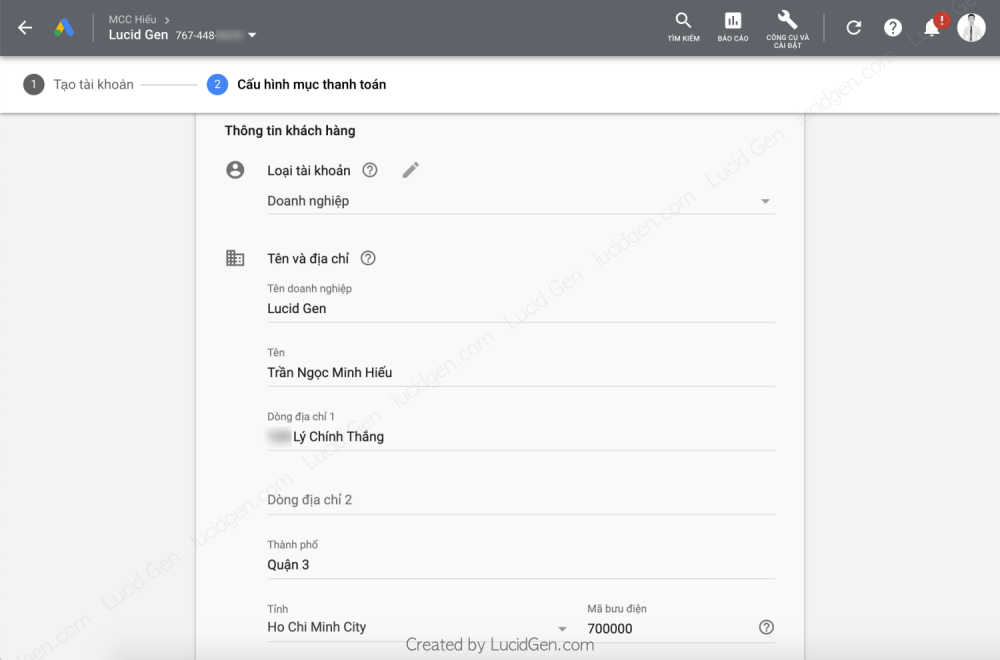
In the Specify your payment amount section, enter an amount; here, I enter 300,000 VND, which you can adjust later. The minimum top-up amount is set by Google and may change over time, so check the current figure on the payment page.
In the Payment method section, you can pay by credit or debit card or with a MoMo e-wallet. Here I choose Add a credit or debit card, then fill in the card details in the window that appears:
- Credit or debit card number.
- The month and year the card expires.
- Three-digit CVC on the back of the card.
- Credit or debit card holder’s name.
Then tick the box to agree to the Google Ads terms and conditions and click Submit.

After you submit, Google will charge the payment amount you entered above (300,000 VND in my case) plus 20,000 VND to verify the credit or debit card you linked. Google may refund this 20,000 VND after 5 to 10 minutes, or keep it on hold for a while.
How to link an existing Google Ads account to an MCC
Step 1: Log in to the account you want to link and copy its account ID.
An account that is not yet linked to any Google Ads MCC shows its ID on the right side, as in the screenshot.

An account that is already linked to a Google Ads MCC shows its ID on the left side, as in the screenshot.

Step 2: Go to your Google Ads MCC account and link the account using the ID you just copied.
In the main interface of MCC, click Account > Performance > click the blue Plus sign > Link existing accounts. (2020 interface. In the current interface (10/2026), click the Accounts icon, select Sub-account settings, click the plus button, and choose Link existing account.)
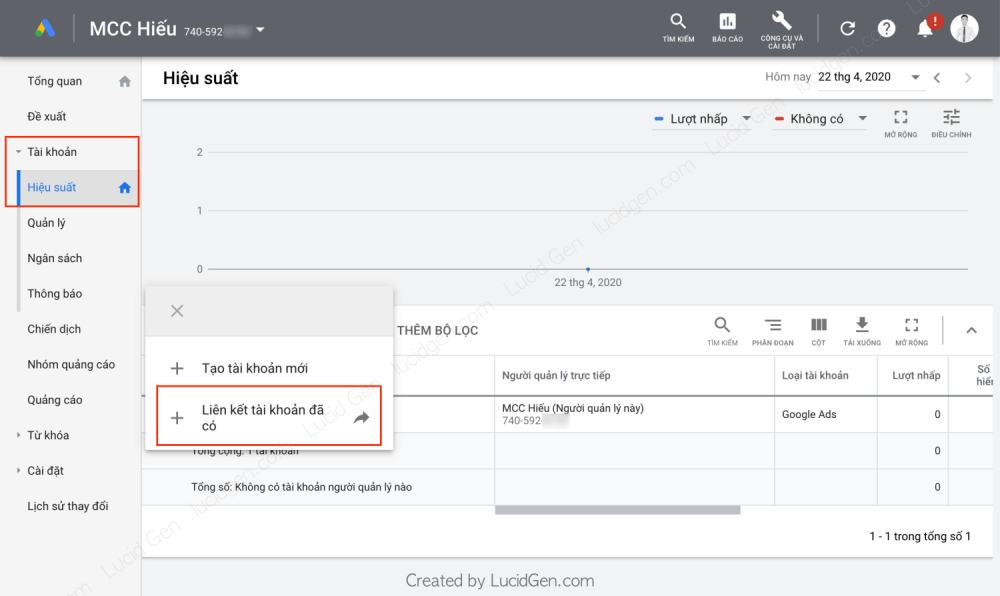
To link several accounts, enter one ID per line. Click the Submit request button to send the link request.

Step 3: Go back to the child account and accept the access request from the MCC.
Sign in to the Google Ads account whose ID you entered above. In the top menu, click Tools and settings > select Account security and access rights. (2020 interface. In the current interface (10/2026), open the Admin menu on the left and select Access and security.)
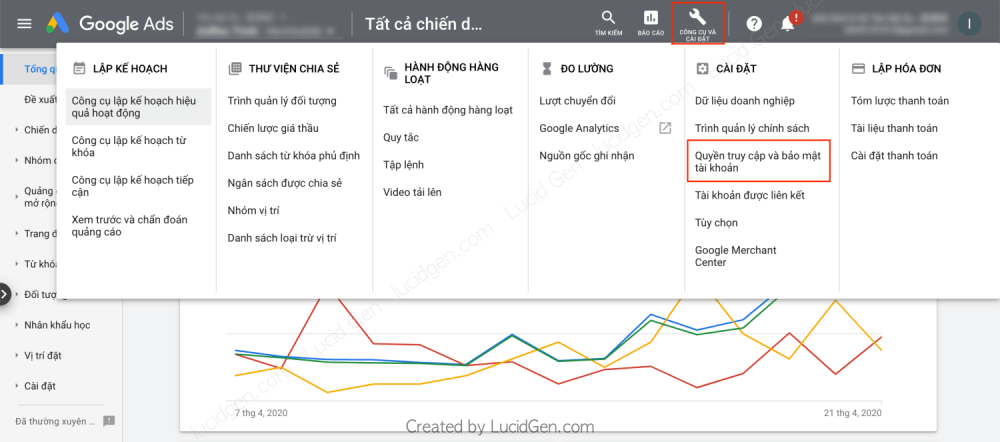
Select the Managers tab > click Accept.

Note: Pay attention to the Admin Owner setting in the image above. If it is turned on, that MCC has the highest level of access and can remove all other managers. You should only enable Admin Owner for an MCC that you trust.
Things to keep in mind when using a Google MCC account
- An MCC is only a management account. It lets you manage your own and your clients’ Google Ads accounts so you can monitor, report on, and adjust campaigns more conveniently. It does not get any special treatment under Google’s advertising policies compared to a regular Google Ads account. So whichever account you use, you still need to follow Google’s advertising policies.
- If a child account only has a few ads disapproved for policy reasons, usually only that account is affected. But if a child account gets suspended, especially for an egregious violation, Google may also suspend related accounts, such as accounts under the same MCC or accounts that share a login email or payment method (see Google’s page on Google Ads account suspensions).
- However, if several child accounts violate Google’s advertising policies and you don’t fix them quickly, the MCC itself may be treated as violating policy and have its ads suspended. Keep this in mind to avoid problems with your MCC.
Conclusion
I hope this article helps you understand what a Google MCC account is, why it is useful, how to create one, and how to link existing accounts to it. If anything is unclear, leave a comment below and I will help as best I can. Good luck!


