

Grouping keywords is one of the most important and time-consuming tasks when you prepare a Google Ads search campaign. I get tired of it too, especially in industries with so many keywords that grouping them feels endless. Most people who run Google Ads know this pain. After reading this article, I hope you will feel a bit of relief, because Lucid Gen is sharing a Google Ads keyword grouping tool built in Excel.
Download Google Ads keyword grouping tool
The tool is an Excel file (.xls) that contains VBA macros. I host it on Google Drive, and you can open it right after downloading. Click the button below to download the .xls file to your computer.
Note: Google Sheets cannot run VBA macros. If you only open the file in your browser, you can view it, but the Group button will not work. You need to download it and open it in the Excel desktop app. Make sure the downloaded file keeps the .xls extension like the original, because the .xlsx format cannot store macros.
Before you start
Before using the Google Ads keyword grouping tool, you need to prepare your keywords and allow macros to run in the tool file. Just follow the steps below.
Prepare keywords
The first thing you need is a list of keywords. In this article, I will use a keyword list for iPhone 7, iPhone 8, iPhone X as an example.

Enable macros for this file only
Because my tool uses macros to group keywords, Excel needs to allow the macros in this file to run. Please do not turn on macros for all of Excel (the Enable all macros option in Trust Center). That setting lets any file you download run macros automatically, which is an easy way to get infected with malware. Enabling macros for this one file is enough.
Step 1: Open the file in Excel. Like other Excel files downloaded from the internet, it opens in read-only Protected View, so click the Enable Editing button to start editing.

Step 2: Enable macros for the file. On the yellow Security Warning bar, click the Enable Content button. This only allows the macros in the tool file to run; Excel keeps blocking macros in other files as usual.
Step 3 (optional): Unblock a file downloaded from the internet. On Windows, if you do not see the Enable Content button but a red bar saying “Microsoft has blocked macros from running because the source of this file is untrusted”, close the file. Right-click the file, choose Properties, tick Unblock on the General tab, and click OK. Then reopen the file and repeat Step 2. These steps follow Microsoft’s official guide.
On Excel for Mac it is simpler: when you open the file, Excel shows a dialog about macros, and you just choose Enable Macros.
Once macros are enabled for the file, we can move on to the part you have been waiting for: using the Google Ads keyword grouping tool.
How to use the tool
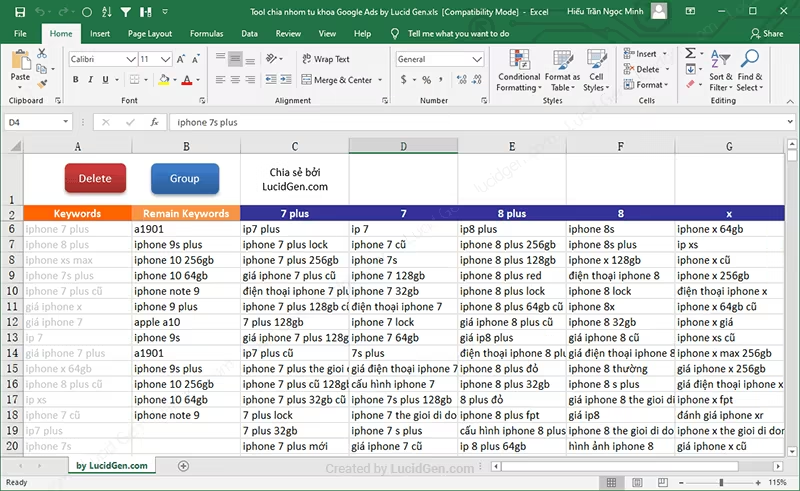
Open the keyword grouping tool and paste in the keyword column you prepared. My example is about iPhones. Next, I enter the words that decide each group, such as 7 plus, 7, 8 plus, 8, x, in the blue bar. Then click the Group button and the tool will group the keywords under those column names automatically.
Tip: put the longer group words on the left. In my example, 7 plus comes before 7, so the tool picks keywords for 7 plus first, then assigns the remaining keywords to 7. If you do it the other way around, 7 plus will end up empty because 7 has already taken all of its keywords.

The tool groups the keywords instantly, at the speed of light (wow, works like a charm). Of course, some keywords will not fall into any group because they do not contain any of the group words. They stay in the Remain Keywords column, and you can add them to another group or use them as negative keywords, for example. You can see the result below.
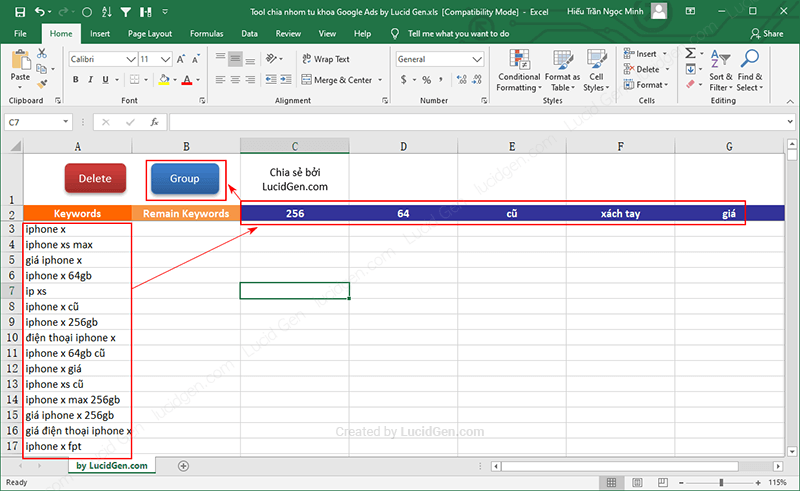
Copy the results to a new Excel file to save them. You can also group further. For example, to break down the iPhone X keywords, copy the iPhone X column and paste it back into the Keywords column. Skimming through, I found a few words I could use to split them, such as 256, 64, cũ (used), xách tay (imported), giá (price). Enter them in the colored column and click the Group button again.
And here are the iPhone X keywords, grouped one level deeper.
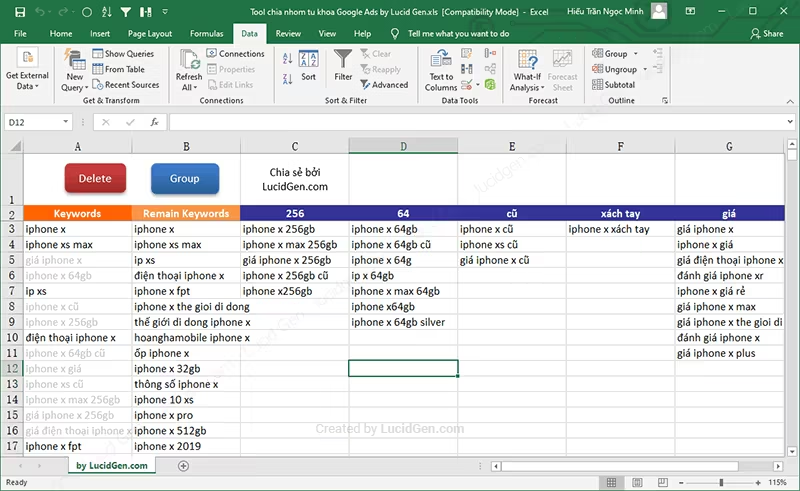
This is just a simple example to show how the Google Ads keyword grouping tool works. Every industry, and every person, groups keywords differently, so do it your own way as long as the tool saves you time.
Conclusion
Ask 10 people who run Google Ads and 9 of them have probably wished for a Google Ads keyword grouping tool like this, without knowing where to find one. Visit Lucid Gen from time to time. I still have plenty of Google Ads topics to share, I just need the time to write them.


