

Making an automatic table of contents for an essay or thesis seems simple, but it can be tricky if you’re not familiar with Word. Here are some common problems:
- Headings aren’t set up with multiple levels, so the table of contents is incomplete or every heading ends up at the same level.
- How do you put the table of contents on its own unnumbered pages and make the main content start from page 1? This part trips up a lot of people, but this article will walk you through it.
- The headings and the table of contents are poorly formatted and hard to read.
- Page numbers and headings don’t update when you change the content.
Those are the main problems, so let’s get to work.
Set up headings in Word
To use headings in Word effectively and save time on formatting, you should set up multiple heading levels from the start (usually 1 to 6). I say “create”, but these headings already exist in Word. Word just doesn’t show all of them to you.
Show the headings you need
On the Home tab in Word, click the Styles button or press Alt + Ctrl + Shift + S to open the Styles pane.

Check Show Preview to see how your headings are formatted. To hide the styles you don’t need, go to Options and uncheck everything. Select New documents based on this template so the setting is saved permanently (otherwise it only applies to the current file).
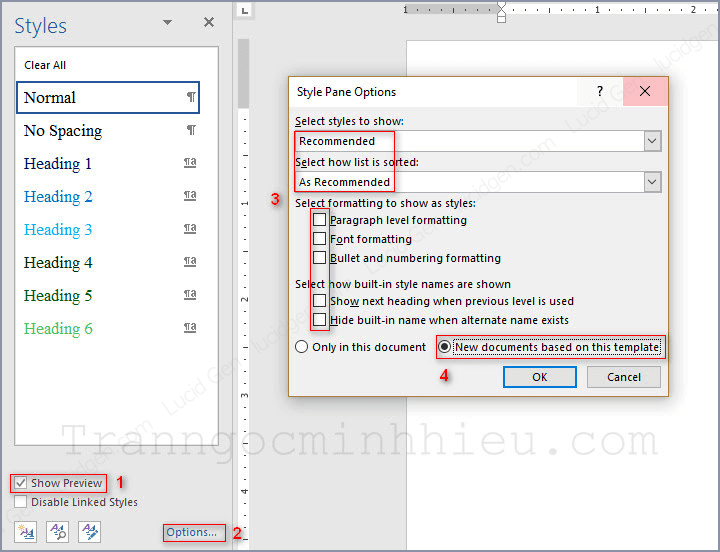
Now the list is much shorter, but some styles you need are missing, such as Heading 3 to Heading 6. Show the headings you need and hide the ones you don’t, as shown below. Remember to check New documents based on this template.

OK, your Styles pane should look much cleaner now. But the headings still look a bit ugly compared to the ones in my screenshot, so the next step is to format them.
Format headings in Word
Click the arrow next to a heading and select Modify to open its formatting options.
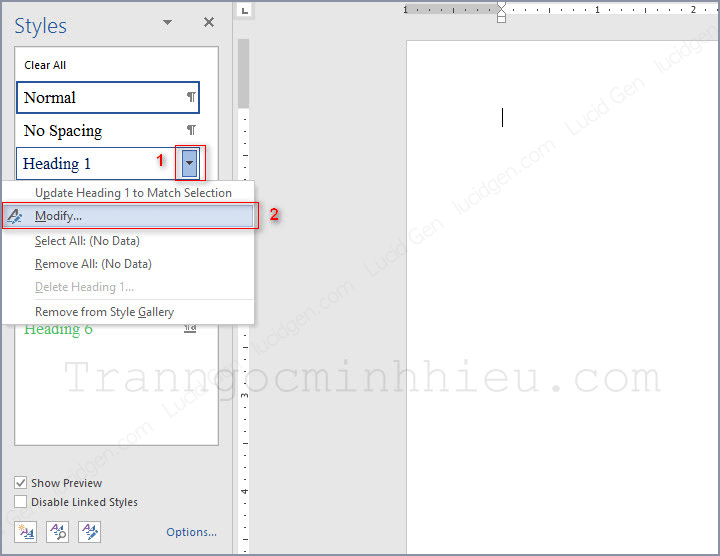
Keep in mind that these headings don’t follow the font, font size, font color and paragraph settings you’ve set for your body text.
It’s best to format them like your normal paragraphs, without italics. You can give them any color you like so they’re easy to spot while you work, and when you’re done, just press Ctrl + A (select all) and change the color to black.
When you’re done with the font settings (1), go to Format > Paragraph as shown below.

In the Paragraph window, the only difference from your body text is in the Spacing section. Set Line spacing to match your body text, and set Before and After to somewhere between 0 and 2.
For a clean look, I recommend using the same paragraph settings for all headings. Simple is best.

Repeat this for every heading, and whatever you do, remember to check New documents based on this template. Don’t forget!
To check that the settings were saved, press Ctrl + N to open a new file and see if the headings look the same. If not, close the new file and go back to the heading you forgot to save with New documents based on this template.
All good! Now let’s do the rest: adding the automatic table of contents.
Create an automatic table of contents in Word
Creating a table of contents in Word like the one in the image below will save you a lot of work. Just follow the steps below in order.
Apply headings to your titles
To manage headings easily, open the Navigation pane with Ctrl + F as shown.

In the Navigation pane, select the Headings tab to see how your headings are organized.
For example, Chapter 1 below is the highest level, so I set it as Heading 1 (put the cursor on that line and click Heading 1). Chapter 1 immediately appears in the Headings tab of the Navigation pane, as shown below. Do the same for the other titles and check the Headings tab to make sure they’re in the right place.

To remove a heading, click Normal. When you’re done, remember to press Ctrl + A and change the text color to black so the headings aren’t so colorful.
Once every title has a heading applied, you’re ready for a nice table of contents. Let’s continue with the next steps.
Insert a section break in Word
Usually, the main content should start from page 1. The problem is that the table of contents and other front pages end up taking page 1, so the content starts from a different page number.
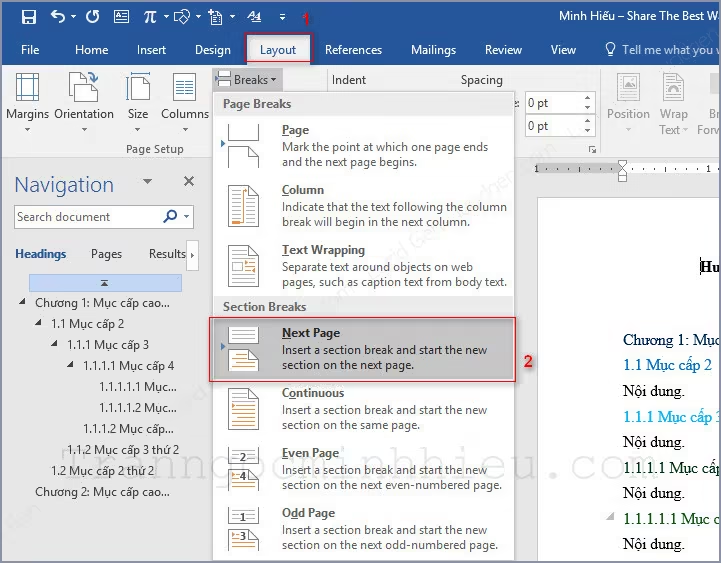
Put the cursor where you want to break the page, go to the Layout tab, open Breaks and select Next Page. Why?
- Page: Breaks the page within the same section, so page numbers continue.
- Next Page: Starts a new section, so you can set page numbers separately for the 2 sections. The goal is for the main content to start at page 1, while the front pages have no page numbers or use a different format.
Now add page numbers to the footer. You probably already know how: go to the Insert tab and select Footer as shown below.
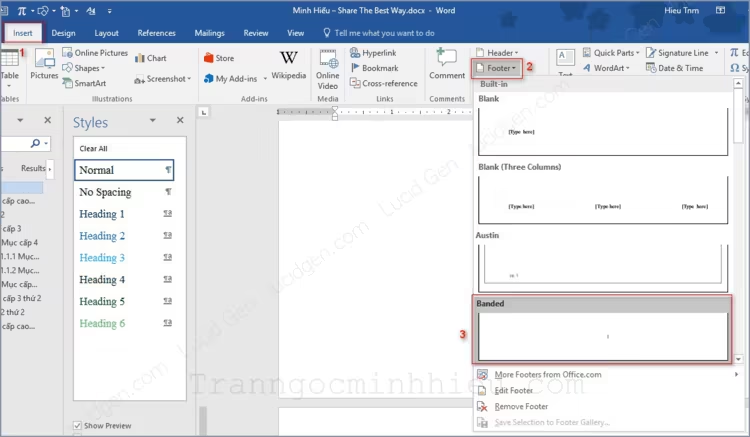
You’ll notice that the page numbers in the front section and the content section are still linked, right? Follow the steps below to make them let go of each other.
Scroll to where the 2 sections meet and double-click the footer to edit it. You’ll see the labels Footer -Section 1- and Header -Section 2-.
Click in the header of the first page of Section 2, then in the footer of Section 2, and click the Link to Previous button each time to unlink it from Section 1.
While a section is still linked, the button is highlighted. When the highlight goes away, they’re unlinked.

Next, make the first content page start at 1. Double-click the footer of the main content section. On the Insert tab, click Page Number and select Format Page Numbers.
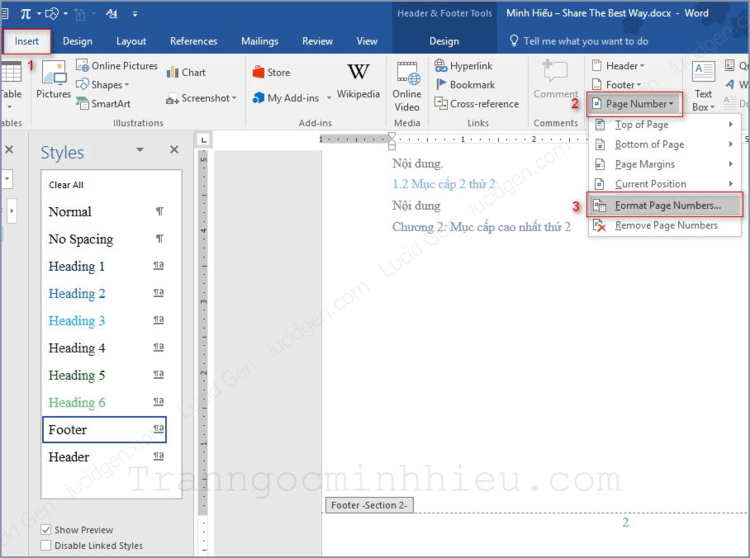
Select Start at 1 as shown below and click OK. For the other section, double-click its footer and delete the page number.

That’s it, the section break part is done. It’s a bit confusing at first, but you’ll get used to it.
Insert a table of contents in Word
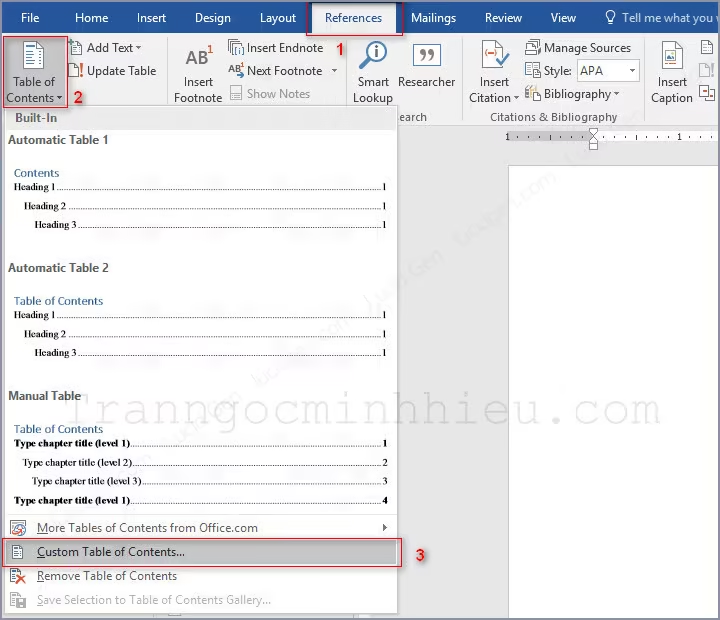
Put the cursor where you want to insert the table of contents, then go to the References tab and click Table of Contents.
The important thing here is not to pick one of the built-in templates, because they’re quite limited. Select Custom Table of Contents as shown below for a nicer result.
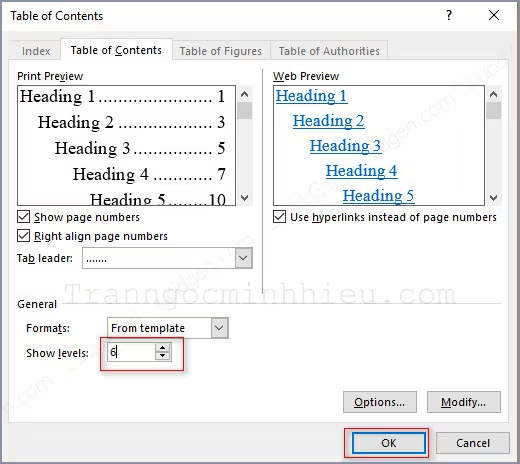
In the Table of Contents window, the only thing you need to care about is the lowest heading level in your document. For example, the lowest level I use is 6, so I enter 6 in Show levels and click OK.
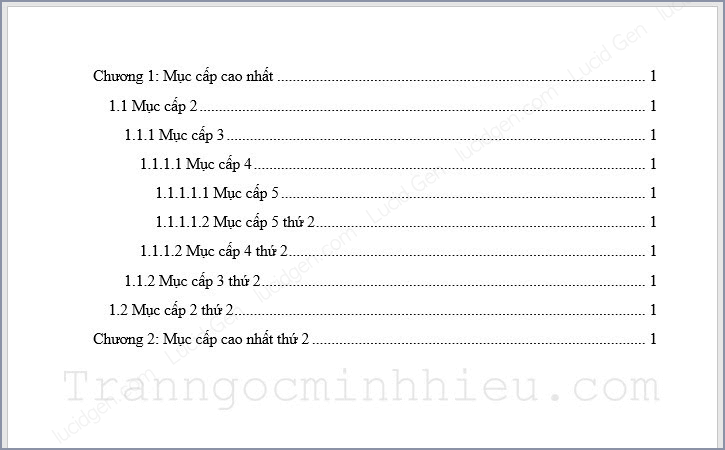
And here’s the result. Headings of the same level line up together, and lower levels are indented further so the structure is easy to follow.
If you edit a title or your content moves to another page, update the table of contents by going to the References tab and clicking Update Table.
- Select Update page numbers only if you only need to update the page numbers.
- Select Update entire table if you want to update both page numbers and heading names.

Video tutorial to make a table of contents with headings
I also made a short video so you can see the whole process in action. The video only shows the steps, while the detailed explanations are in this article.
Conclusion
That’s how I use headings and automatic tables of contents in Word. Do you have any tips to make it better, or is there a step you don’t understand? Leave a comment below and let me know.
This article is based on Word 2016. Creating a table of contents in Word 2010 and other versions works the same way.
The menus might be in slightly different places, but you’ll get there in the end.
Good luck!


Hello
Hello bro!
Hello!
This is by far the most straight forward, easily explained tutorial I have come across. Thank you 🙂
Yeah, I’m happy to see your comment.